ラボール英会話教室.png)
Hi, Kris here.
I have been teaching English for roughly 25 years now, and I have also been trying to speak Japanese for about the same amount of time. What I have come to realize is that improving at something is not really down to “talent”. It is more about creating good habits and sticking to them.
In this blog post, I will try to explain a few things that I feel both I and some of my students struggle with while learning a language.
Note: The following are only ideas, not scientifically proven facts, so please feel free to disagree with them!
Learning a language is a “long road”!

Don’t: think about the final destination.
Do: enjoy the journey.
It is easy to put the cart before the horse (本末転倒) and focus only on getting better. However, the whole purpose of language is to communicate and build relationships with other people.
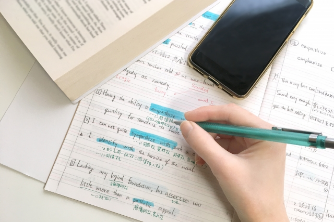
Don’t: always write everything in your notebook.

Do: listen in class & speak lots in practice activities.
When I first started studying Japanese, I had many notebooks full of “must-learn” words and phrases. The problem was that those words stayed in my notebooks, not in my head.

Don’t: wait in silence.
Do: talk more, ad-lib, ask you teacher what to do.
Try not to race through questions. Instead, try to find out more about your partner.

Don’t: worry about making mistakes.
Do: try new words, expressions and ideas.
This one is a biggie! The classroom is the place to make mistakes. Once, I asked for “a pump for my subway train”. I was really embarrassed by my mistake, and the old man in the bicycle shop said to me, [ないわ!] It was embarrassing, but I also learned a new expression.

Don’t: read all the time in lessons.
Don’t: pre-read the listening exercises.
Do: listen without reading.
This is another big one. If you read the script of a listening exercise, you may answer the questions correctly in class, but when you actually talk to other people in English outside class, your listening skills may not improve as much as they could.

Don’t: read a newspaper or Shakespeare, or watch hard-to-understand comedy shows.
Do: Use the internet, borrow books from Labor’s library, & talk lots.
You will make better progress if you read and listen to things that are suitable for your level.


Don’t: study 5 hours in one day.
Do: study 10 or 30 minutes every day.
Don’t: study boring things.
Do: Find things that are interesting for you.
Nowadays, with the internet and YouTube, you can learn about almost anything you like in English.

Don’t: try to be ‘perfect’.
Do: try to answer smoothly & quickly.
We do not usually give speeches in class, so you do not need to speak perfectly. Just try to get your ideas across as clearly as you can.
Don’t: talk for too long
Do: make eye contact, wait for reactions and questions from your partner.

If we have a lot to say, it is easy for a conversation to become a monologue. Try to pause and allow your partner to react, comment, or ask questions.
If your partner does not react, maybe they do not understand you. Or maybe they are daydreaming about lunch! Lol
Finally, if you are you looking for a good website you could try these:
For a quick 5 minute lesson every day, click here: www.duolingo.com
If you are interested in listening practice, click here: www.elllo.org
And for pronunciation on YouTube, click here: Rachelsenglish.com

Happy studying!!